Showing Us What is Possible: A New Vision of Work from Charpentiers Sans Frontières*
Table of Contents
Showing Us What is Possible: A New Vision of Work from Charpentiers Sans Frontières*
By Joshua A. Klein
(*) This essay is republished from Mortise & Tenon Magazine, Issue eight (2020). https://www.mortiseandtenonmag.com
Sometimes it feels impossible to imagine any other way of doing things until you see it done by someone else first – I had just one of those experiences this past summer. Charpentiers Sans Frontières (CSF), “Carpenters Without Borders,” is a France-based timber-framing team that my colleague, Michael Updegraff, and I were introduced to in 2017. That September, our friend Will Lisak traveled to Romania with the group and wrote about their project.1) CSF travels the world to restore medieval masterpieces such as Château d’Harcourt, Château de Gaillon, and a 1491 barn in Aclou. This group, founded and led by François Calame, an ethnologist in the Ministry of Culture in Normandy, gathers skilled carpenters from all over the world.
What impressed us so much about this group was that their work was done by hand. Although Mike and I take a hand-tool-only approach to our furniture making, it was hard to envision constructing entire frames without the aid of sawmills, circular saws, or chain mortisers. Of course, we all know it has been done that way for ages, but who in the 21st century would choose to do so? We were sure this must be an interesting group of people.
Through a serendipitous series of events, Charpentiers Sans Frontières spent 11 days at our place in Maine, hand-hewing, joining, and raising a 16' x 25' blacksmith shop in August 2019. During that event, I got a firsthand view of the beauty of their work – work that is grounded in something more purposeful than economic expediency. I saw joyful, sweaty, skilled camaraderie that forged new relationships not only across borders but also with nature. This event brought back together those most basic and human elements of life (food, work, song, community) that should never have been separated in the first place – it was a constructive alternative to the division, rivalry, and greed that pulled societies apart. My life will never be the same after this event. If I had only one goal for this article, it would be to share the beauty of the engaged and passionate life that these carpenters exemplified – one in which the work of the heart is just as important as the work of the hands.
A New Perspective of What is Possible
The construction took place over eight days, and the frame was raised in one-half day. This build was an inspiring demonstration of understanding and skill. Moreover, another work is possible: Instead of working in isolation, dependent on machinery and manufactured building materials, we can claim our humanity by learning to use simple tools to create structures of lasting beauty. We can pick up a rusty axe that’s already had two centuries of use, give it a fresh edge, and set it to work to accomplish incredible things. And because this way of building is an investment in labor rather than expensive machinery, it is something that anyone can do.
It’s not necessary to fly to another country or host 40 carpenters. With nothing more than an axe, a chisel, and a saw, you can learn to shape your environment. Average folks throughout history did this kind of thing themselves – every farm had an axe or two for such projects. Even though professional carpenters have been around a long time, in the pre-industrial mindset, hewing logs into timbers was simply an unremarkable thing to do. It was the job you hired local kids to do with you.
The people I know building their lives with their two hands succeed by simplifying their obligations and doing things for themselves. It’s amazing how much time and opportunity open up when we minimize the amount of stuff that we have to maintain and reduce the “necessary” expenses in our lives. Bill Coperthwaite built beautiful, simple yurts on his property in rural Maine and filled them with handmade things even though he “never had much money” and ended up “living all of his life well below what our government calls the poverty line.” Bill made this possible because he made a “consistent choice of time over money” throughout his 55 years in his “experiment in living.”2) He succeeded because he refused to get sucked into the rat race.
The Carpenters Without Borders team has also shown us that physical work is even more fulfilling when done with friends and family. There’s a lot of work to be done at a project like this that has little to do with an axe edge or timber. Sure, there’s hewing and hauling, but there’s cooking, feasting, laughing, and good stories to tell. CSF models the power of joyful handwork. Through their efforts, we’ve not only seen that many hands make light work (which is very true!), but also that the bonds built through sharing labor and sweating side-by-side prove to be the most rich and lasting.
Hewing
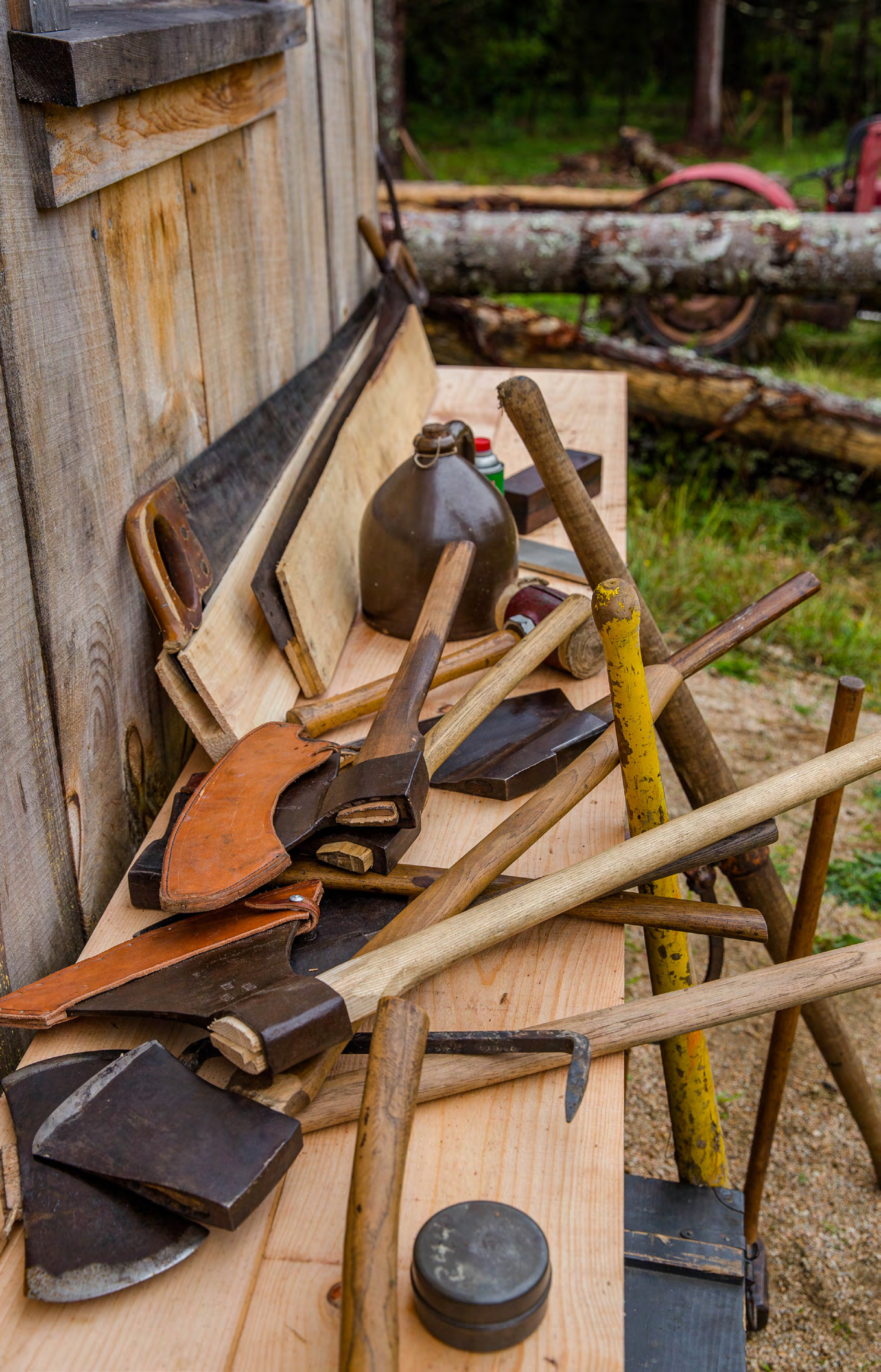
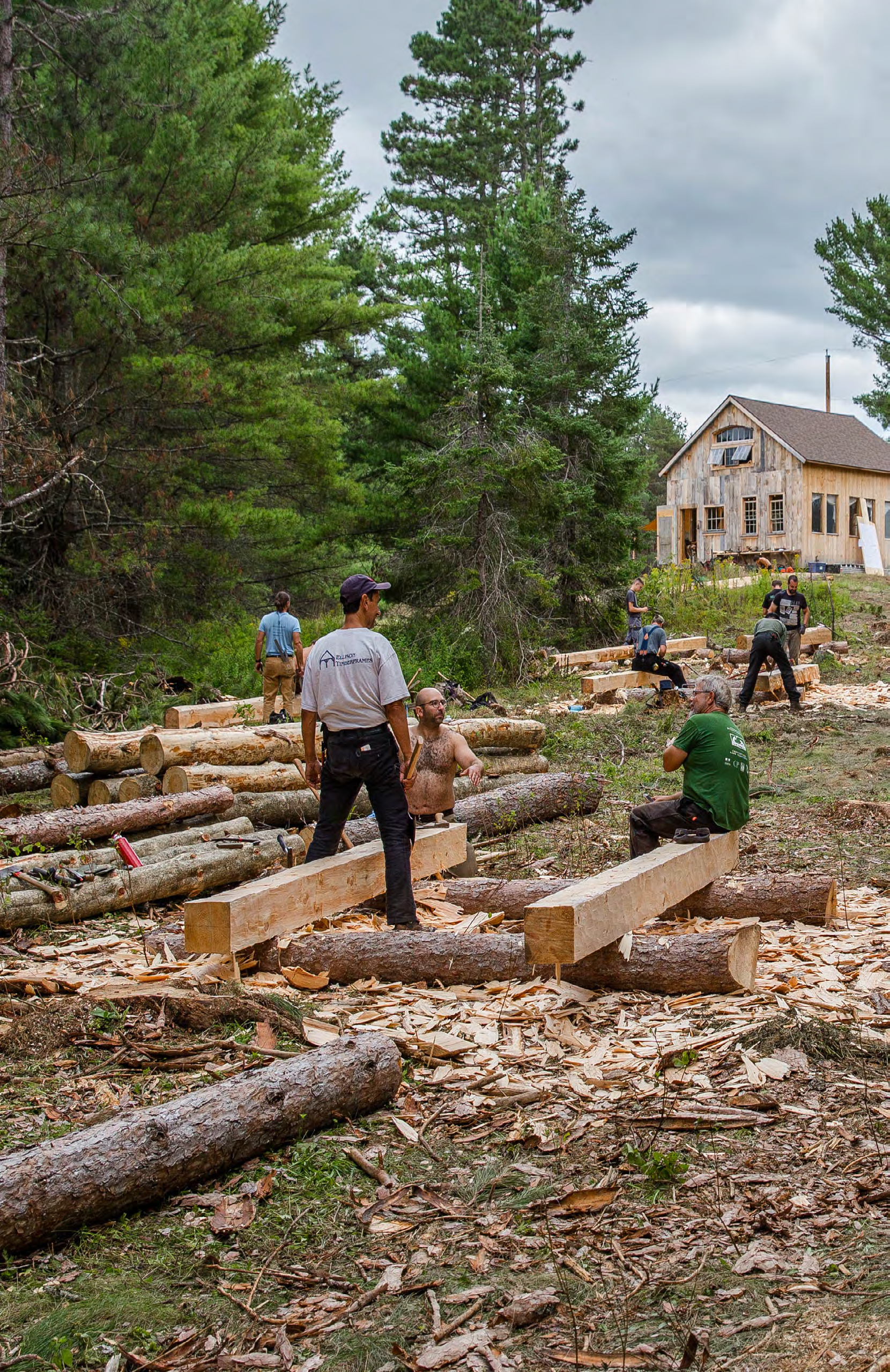
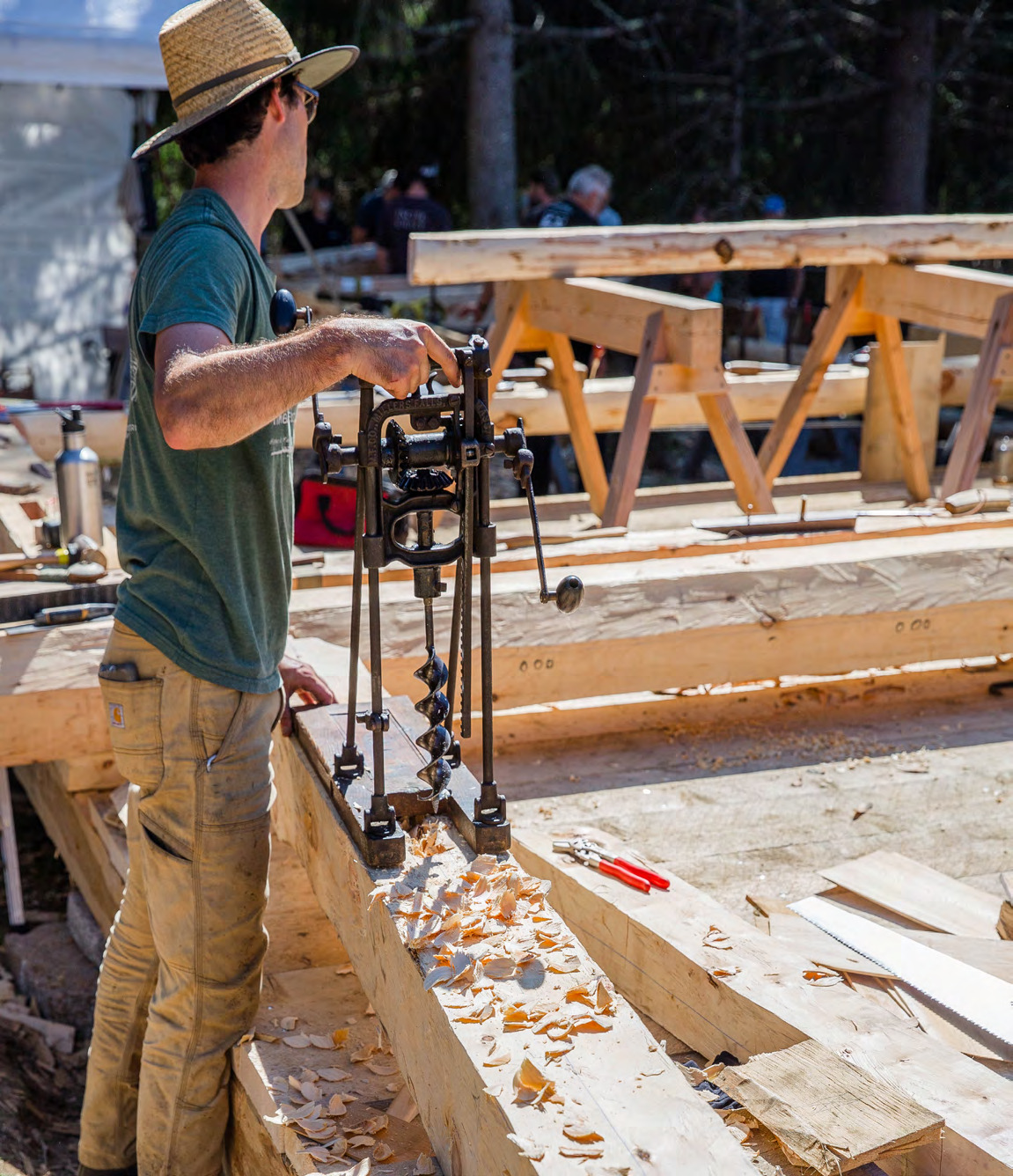
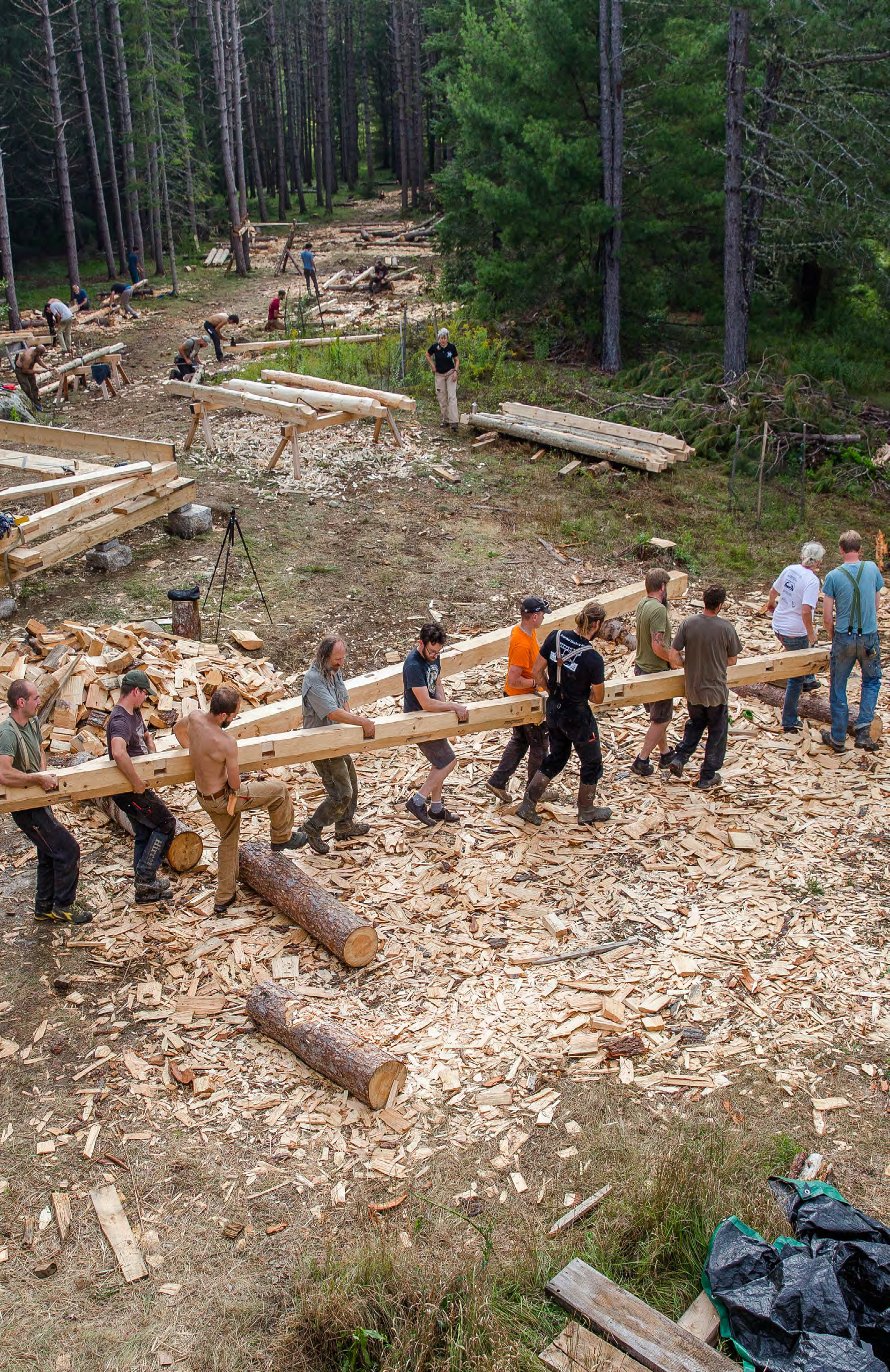
The teams set the logs on “bunks” to keep their axes out of the dirt while hewing. Putting the work up on these red pine offcuts gave the carpenters at least a foot of clearance to the ground and raised the work higher. Each log was secured by rolling with log dogs (essentially, big iron staples) on the opposite side of the face to be hewn. These log dogs were each unique in size and shape, being mostly blacksmith-made.
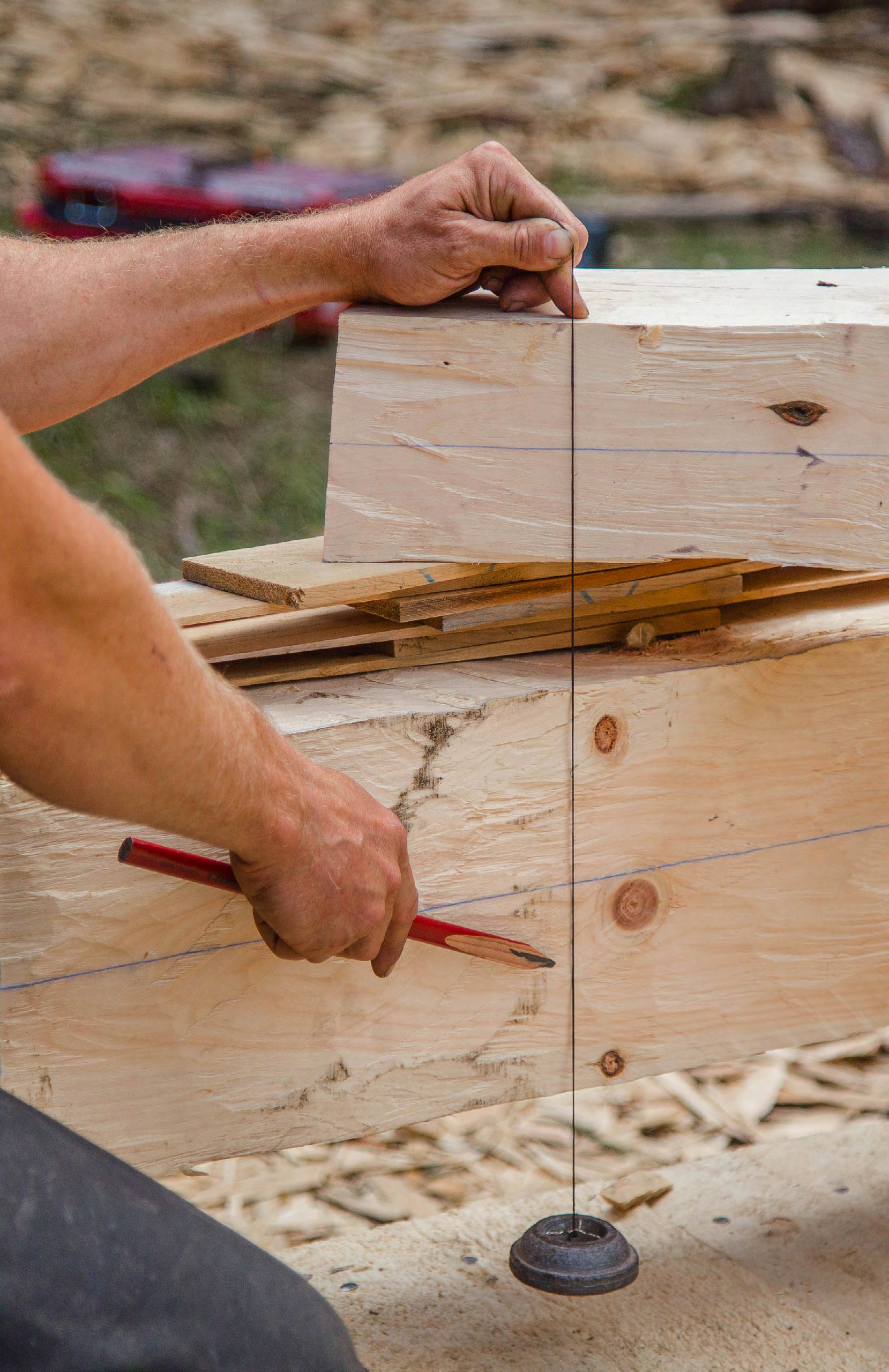
To lay out lines for hewing, the timber’s cross-sectional dimensions were drawn onto both ends of the log, with their sides established plumb. The Americans typically used spirit levels, but some French carpenters used plumb bobs to establish these lines. Once the ends were drawn, they were connected down the length of the log with the snap of a chalk line, making a straight timber from the natural, irregular tree. In most cases, the carpenters peeled a strip of bark only where the lines would be snapped rather than peeling the entire log. This served two purposes: First, it saved labor because peeling bark in areas that were going to be hewn away would be wasted energy; and second, the bark provided a grip for standing on when working the log underfoot. Freshly peeled logs are slippery.
The lines were snapped carefully. Although the subtleties of using a chalk line are something I never really thought too much about, when snapping lines on irregular pieces (such as logs), it is critically important to lift the string exactly plumb so that it is in plane with the sides of the timber; otherwise the line will snap out of plane in low spots. To ensure that the taut line was plumb before letting it go, another carpenter would sight the line for them. “No, a little to the left. A little back. There.” Snap! This way, a dead straight line could be achieved no matter the topography down the length of the tree. In addition to a trained eye, squares and levels were sometimes used to ensure the line was plumb before snapping.
With the finished member marked out, all left was to remove everything that wasn’t the timber.
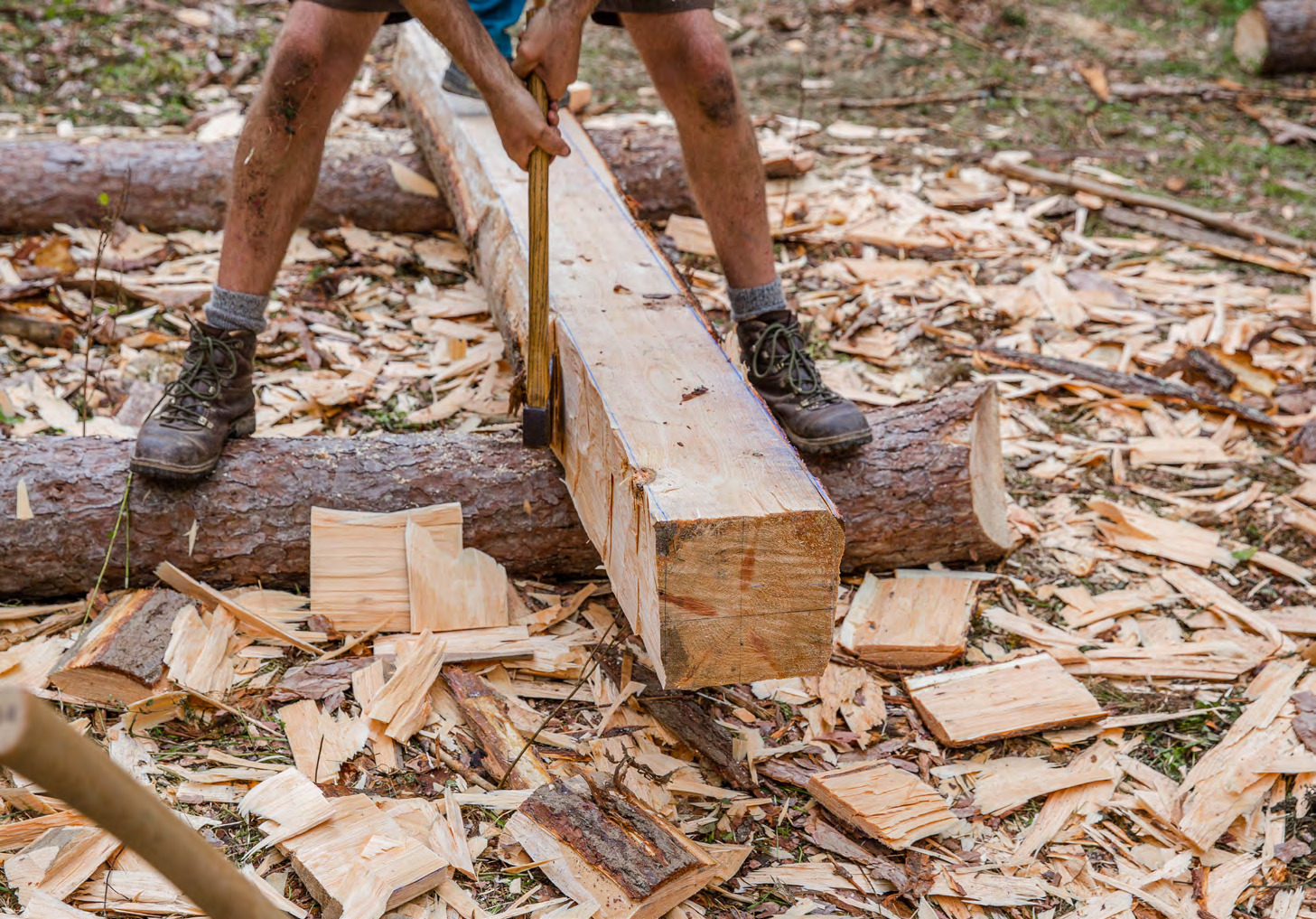
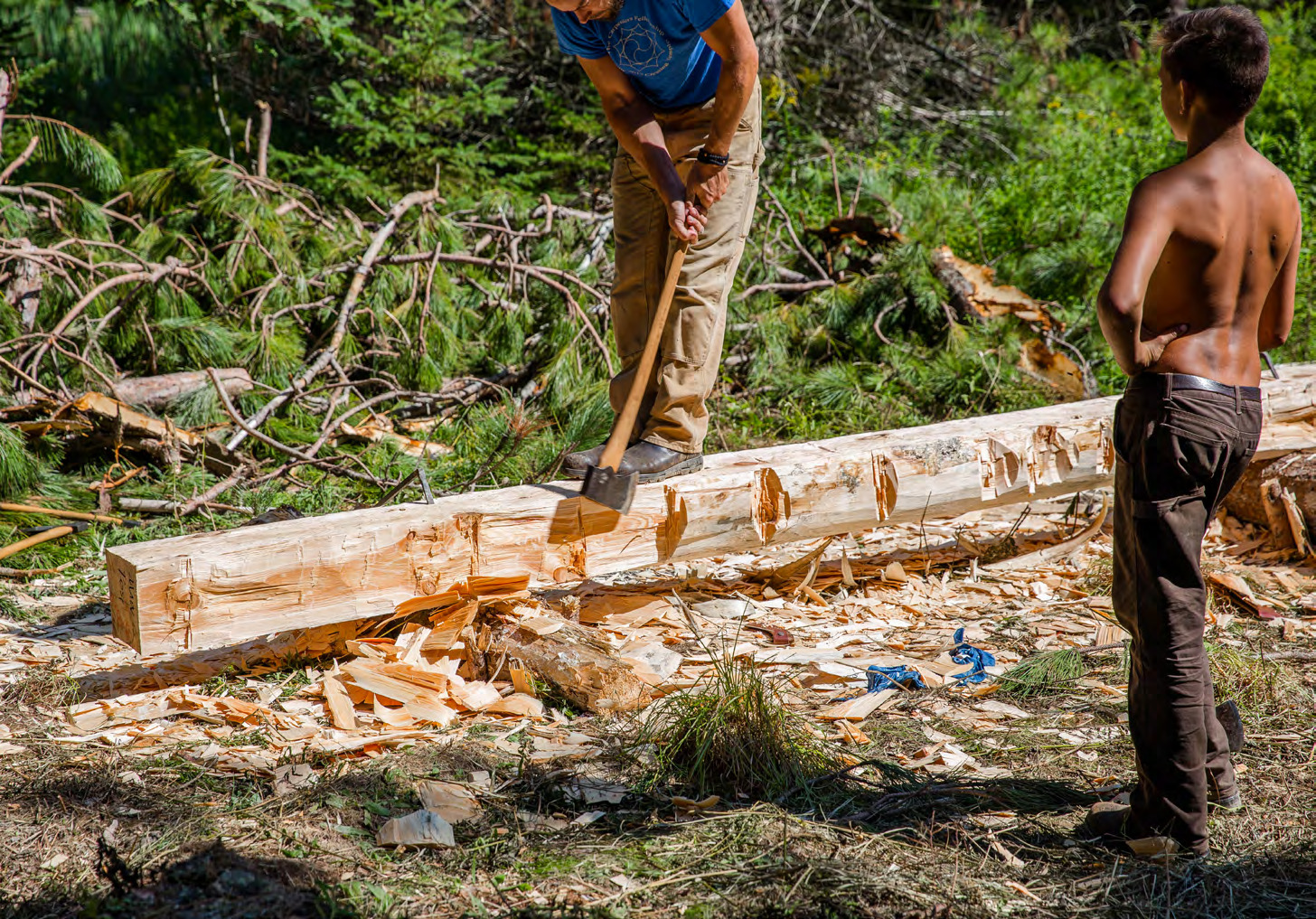
This was accomplished in three steps: scoring/notching, joggling, and hewing. The first step is providing cross-grain stop cuts via regular kerfing with the two-person crosscut saw or by notching with the axe down the length of the log. The waste areas between the notches are then “joggled” off the log by swinging a long-handled felling axe parallel to the tree’s fibers. Ideally, this coarse stage leaves no more than 1/2“ of material to remove with the hewing axe (the axe equivalent of the smoothing plane).
This joggling process is a bit awkward to get used to because it is often done while standing on top of the log, swinging a long-handled felling axe beneath your feet. Maintaining your balance while guiding a 4”-wide bit on a 36“-long handle at the end of your fully extended arms requires considerable skill. There is no instruction book or how-to guide that can give secret tips that will enable you to bypass years of practice. This work is about your brain and hands getting to know that tool.
In The Glass Cage: Automation and Us, author Nicholas Carr discusses a fascinating area of neuroscience research called “embodied cognition.” He explains that scientists have found that the “workings [of the brain and body] are interwoven far beyond what we assume. The biological processes that constitute ‘thinking’ emerge not just from neural computations in the skull but actions and sensory perceptions of the entire body.” He gives the retina as one example and says it “isn’t a passive sensor sending raw data to the brain, as was once assumed; it actively shapes what we see. The eye has smarts of its own.”3)
The idea that our understanding of our surroundings is formed not only in our brains but throughout our whole bodies is consequential to our relationship with our tools. Carr explains that “our bodies and brains are quick to bring tools and other artifacts into our thought processes – to treat things, neurologically, as parts of our selves. If you walk with a cane, work with a hammer, or fight with a sword, your brain will incorporate the tools into its neuronal map of your body.”4)
Carr tells us that through disciplined practice, our brains begin to think of hand-held tools – such as saws, planes, or axes – as if they are an extension of our arms. This also might shed scientific light on a phenomenon that many woodworkers may have thought too subjective and emotional to repeat within earshot of the more cynical among us: the idea that using hand tools make us feel a closer “connection” to the material we work. Based on the findings of these scientists, that might be true.
When it comes to my tools, I’ve long believed that their unrefined and faceted handles help me to better engage my work. Every little idiosyncrasy gives my brain a positive reference for orientation and cutting angle. When using tools with round, smooth handles, I am completely dependent on visual confirmation to use them accurately. This limitation introduces an element of doubt into the workflow and can slow things down – exactly the kind of experience a working craftsman wants to avoid.
At the CSF project in Maine, the carpenters’ hewing abilities were even more impressive than their joggling – they split the line with their axes all day long as if it was nothing. It was clear that they had spent many hours with these tools, and each axe’s handmade uniqueness strengthened the connection between artisan and tool. The axes on-site were highly individual and varied tremendously from tradition to tradition, but most were French, American, Swedish, or German. Many of the examples had a bevel on only one side. The idea with this style is that the “flat” back (actually slightly convex in both directions) guides the tool in creating a flat surface on the timber.
I wish I could tell you exactly how long it took to hew one 8” x 8“ timber, but honestly, I was so astonished at how fast everything happened that the clock was an afterthought. Mike said he clocked Gustave Rémon hewing the single flat on a 14' rafter at about two minutes. Carpenter Loïc Desmonts calculated the average speed of hewing on this project to be 1.19m2/person-hour. This math means that from rough log to finished timber, an 8” x 8“ x 12' post took around three hours to produce.
I have never seen anything more awe-inspiring than this team of people hewing the entire frame in a little over two days of labor. And, by all accounts, this was at a pretty casual pace. After the eight days of construction, several carpenters came up with independent estimates of the time they would need to build this frame with the same methods. The average bid was four person-months (640 hours) – two people for two months. This is the kind of efficiency that skill can achieve.
A Different Kind of Worksite
It was clear from the beginning that this was no conventional jobsite – no generator roar or shriek of a Skilsaw drowning out conversation. There was nothing here to be heard but the steady thumping of axes, the whisper of saws, and joyful laughter (with the occasional – and somehow fitting – exception of a jobsite speaker playing the Fugees, courtesy of Loïc). It was a rare moment in which there wasn’t someone sharing knowledge or a story with others. It would be easy to mistake this project for reenactment olde-timey ways, but it was nothing of the sort. This week demonstrated convivial and sustainable manual work that is just as relevant in the 21st century as in the 12th.
It would have been something else entirely had we relied on the expediency of machines. This was made especially clear on the days throughout the week when the public came to watch. Folks of all ages were lined up at the edge of the worksite, standing in awe to see people using their hands to turn nature into culture. Grandparents, parents, and children alike were visibly moved by the scene. And in our conversations, I got the sense from some that although they thought they had come to watch burly carpenters manhandle massive logs, they discovered instead a display of respectful collaboration – of nature “manifest[ing] itself through the medium of human beings.”5)
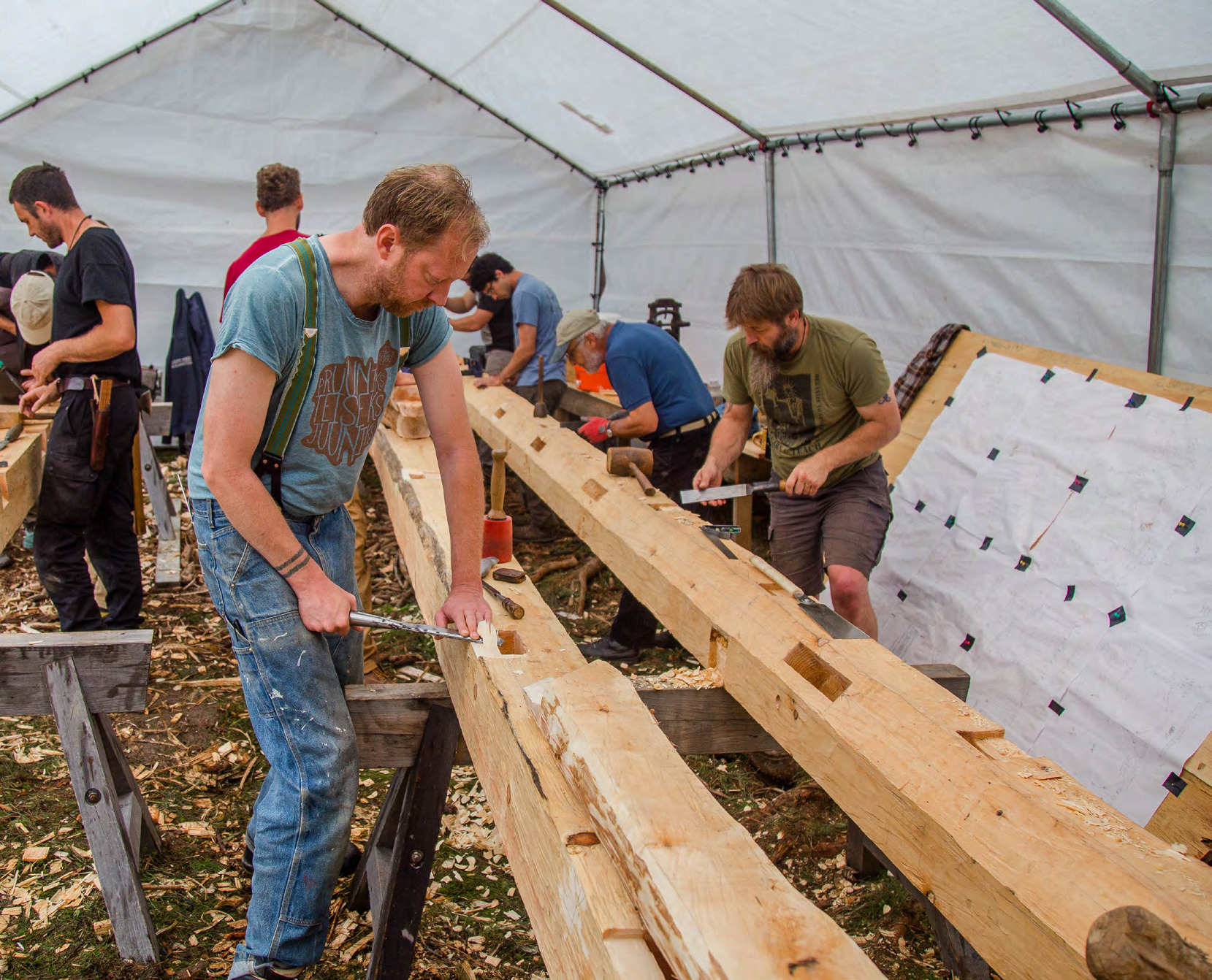
On day three of our project, the carpenters were laying out joinery, and by day four, tenons emerged, and mortises were chopped. The layout was a focal point of this project because one of the primary objectives was to have the foreign crew learn the American square-rule method. This system relies on cutting shoulder reductions to a fixed depth, which accommodates the irregularities of hewn or rough-sawn surfaces. It’s often described as envisioning the “ideal timber within.” Because a hand-hewn or rough-sawn 8” x 8“ post is potentially 1/4” smaller or larger at any point, a reference edge or line is designated, and shoulder reductions are cut to the “ideal timber” diameter of, say, 7“. By making these reductions all the same depth from the reference, you know precisely the shoulder-to-shoulder measurement for the post’s mating timbers. This system couldn’t be more different than the French method of scribing the timbers to their mating members using plumb bobs.
Joyful Engagement
If I had to describe the spirit of the crew during the construction in one word, it would be “joy.” Everyone took their work seriously, but they also looked like they were having the time of their lives. So many said that even though they may be professional timber framers, they look forward to these yearly CSF vacations in which they are unfettered by the usual economic constraint of the bottom line. Many concurred with carpenter Will Gusakov’s reflection that this was the type of work they want to do.
There is joy to be found in good work that is done well, but if we accept the contemporary paradigm that all physical work is inherently onerous, we tacitly affirm that withdrawal from this activity is desirable. We fill the void with an indiscriminate embrace of the commodities of convenience, forgetting that there is indeed something about manual labor, especially when done alongside others, that seems to fulfill our humanity. But it is easy to lose sight of this while living in a culture of comfort and detachment from the beautiful realities of raw, gritty life – such necessities as the tending of farm animals and construction of buildings.
Mihaly Csikszentmihalyi’s now-famous analysis of what he calls “flow” explains a direct relationship between our skill, the challenge we set before ourselves, and our happiness. A proper balance between skill and challenge must be maintained because if the challenge at hand exceeds our skill set by too much, discouragement sets in, or if our abilities far exceed what the task demands, we are afflicted with boredom. Both lead us to discontent. Csikszentmihalyi tells us that joy can be found in constantly pursuing higher skills that demand ever-higher challenges. Through this process of skillful engagement, we grow in competence and personal satisfaction.6)
Learning to engage with the world through handcraft is one of the most powerful ways to cultivate joy in this life. Seeing the satisfaction blazoned across the faces of these carpenters couldn’t have made this point clearer to me. Projects like this are a vivid reminder that “work is a good thing for man” and that it is possible to envision a future that embraces the benefits of modern technology without its dehumanizing tendencies. Let us never forget, in our pursuit of technological development, that the well-being of our humanity will be ignored only to our detriment.
Sabotage
For many folks working on this timber frame project, the axe was and is the physical embodiment and symbol of these alternative possibilities available to us. The simple act of taking up tools is a trailhead to the path toward independence. With them, we wield the means to build the world we want to see. It is a small thing to learn to use an axe. But a life comprised of many such down-to-earth and constructive decisions is the framework for a new way of seeing the world – one rooted in empowerment, compassion, and freedom.
As one of the CSF carpenters, Florian Carpentier, put it, “[The axe is] one of the most basic tools since humanity [came into being]. And with just these few tools, some of them I am able to make myself, I can build comfortable, durable houses to shelter people. Many people are nowadays on a quest for meaning in their life. They don’t see the point anymore in working so much, earning so much money, spending so much, and having so little time for family, friends, and themselves. You have the slow food movement; we are the slow construction movement. It’s a provocation. It’s like sabotage to the big machine. We show that we can go against the machine at our little level. But we have an impact. Even though it’s small, we have an impact, and we must use it. It’s not like I will save the world with my timber frames, but at least I do not destroy the world, which is already very good.
“Whatever you can do to make sabotage, you have to do it. [For my part,] I participate in creating good living conditions for people who will live in my houses. I contribute to maintaining the balance of nature and the ecosystem by using local trees, low technologies, and low-impact processes. This is meaningful because the important thing we need is not the machine, it’s what I have in my hands: my skills. The human is put back in the central position in the process of building.”
Beyond Borders
Having the deck in place on Wednesday morning enabled the carpenters to progress to the next step: scribing the curved braces into the bents. In turn, each team assembled their assigned bent horizontally on the deck, and the whole thing was leveled to establish a flat reference plane. The carpenters could then lay the curved braces on top of the bent in their positions and transfer the shoulders, relying on a plumb line instead of a square. Transferring layout like this is an ancient but effective method for dealing with the irregularities of hewn timber. Square-rule and scribing are two different ways to accomplish this, but squares depend more on regular material. Plumb bobs will always reference the center of the earth, no matter where they’re hanging.
Hanging a plumb line from the upper face of a brace to the lower face of a post, any out-of-squareness is readily apparent on both members. Say the string touches the bottom corner of the post but is 1/4” away from the top corner. This 1/4“ offset must be marked on the brace. Likewise, the irregularities of the brace must be marked on the post. Because both pieces are not perfectly square, if you want a tight joint, their shoulders cannot be perfectly square either. Using the plumb bob to transfer each timber’s unique irregularities to its mating member, the correct shoulder can be sawn to fit perfectly.
Watching the French team teach the bemused Americans this foreign method was beautiful, the same way that the Americans taught square-rule to their foreign friends. There was some jovial banter throughout the week about the merits of one or the other system, but this kind of cultural sharing is exactly what CSF aims for. And who can deny that the world is more beautiful when people of different perspectives share their vision of life? I was moved to see how this crew uses these projects to cultivate that very thing. They aren’t called Carpenters “Without Borders” for nothing.
And this connection across borders happened at mealtime, too, because the conviviality of sharing a meal creates an opportunity for meaningful conversation that might otherwise be left unexplored in the frenzy of contemporary life. It is a time to embrace, ponder, wonder, and deliberate together. The cooks, seated in the midst, are thanked and praised. A toast is made for more moments like these. Philosopher Albert Borgmann has put it, “In the preparation of a meal, we have enjoyed the simple tasks of washing leaves and cutting bread; we have felt the force and generosity of being served a good wine and homemade bread… In the simplicity of bread and wine, meat and vegetable, the world is gathered.”7)
This simplicity of communal eating is a profoundly human thing and, like swinging an axe with a friend, enriches our experience of life. It is available to us each day, if we will only make the time for it. Borgmann tells us that “it is within our power to clear a central space amid the clutter and distraction [of our lives]. We can begin with the simplicity of a meal that has a beginning, a middle, and an end and that breaks through the superficiality of convenience food in the simple steps of beginning with raw ingredients, preparing and transforming them, and bringing them to the table. In this way, we can again become freeholders of our culture.”8)
The Raising
Saturday was the big raising day, and we invited the public to watch the momentous occasion. Will Gusakov started the morning meeting by calmly explaining the importance of safety and attentiveness. He laid out the raising plan so that everyone understood. The crew was intent and ready to go. But there were so many carpenters available to help that we all had to wait our turn – too many people on the deck would become dangerous.
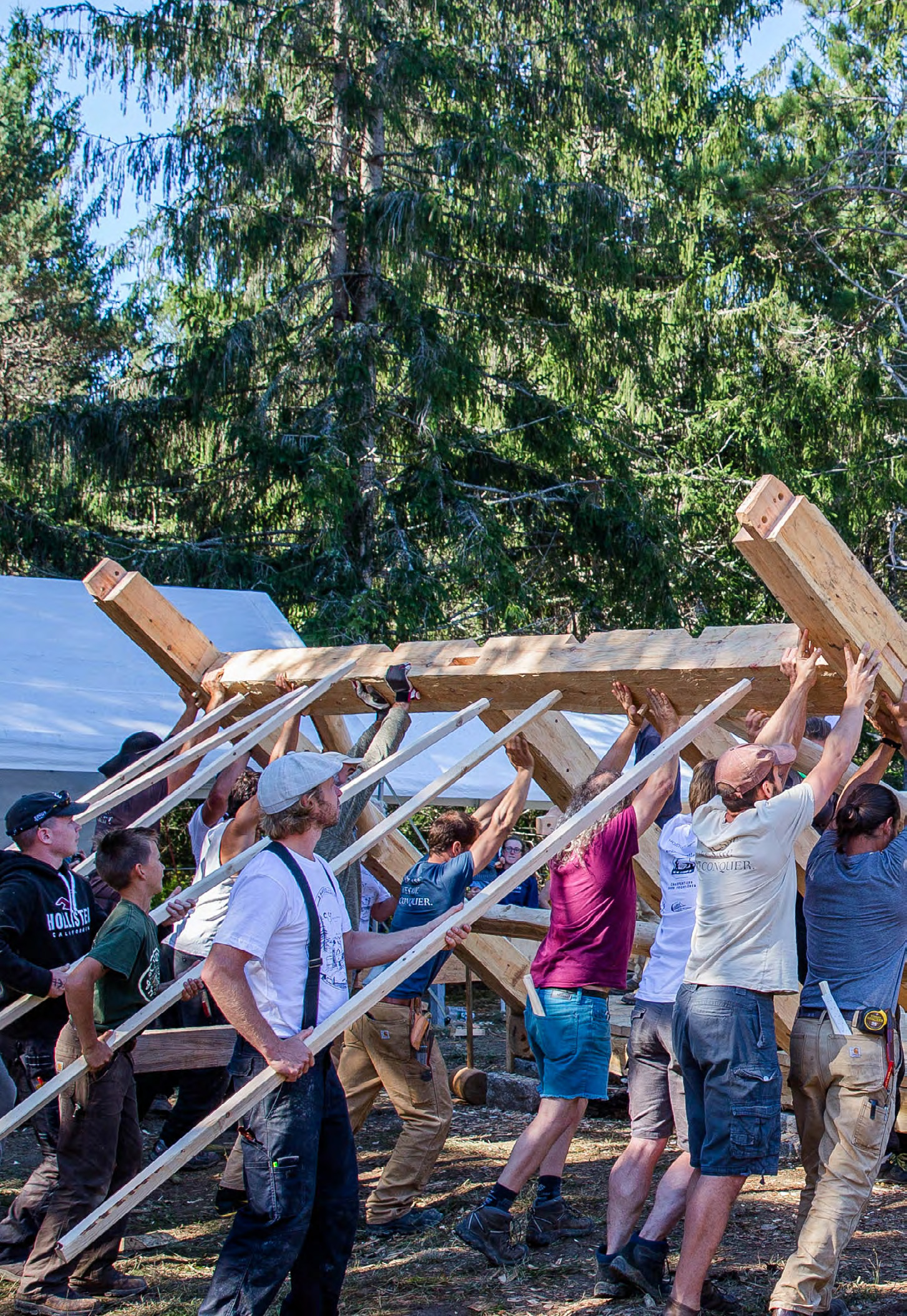
The raising crew was divided into three teams: the lifting, the pike poles, and the ropes to restrain the bent from overextending. At Will’s confident direction, the first bent was lifted off the deck and overhead, at which point the pike poles engaged the tie beam to continue the thrust upwards. Once the bent was vertical, Vermont framer Miles Jenness used the commander (which is essentially a massive mallet) to steer the posts’ bottom tenons into their mortises. When the posts dropped, the assembly was secured with temporary diagonal bracing to remain plumb. Then the remaining two bents were assembled and raised.
The next step was to lift the log joists into place. These joists dropped into mortises in the tie beams, and the flat hewed on their top sides created a flat plane that was even with the tops of the tie beams to apply flooring.
The plates were lifted with ropes by a team above, a method called “parbuckling.” By tying several ropes at the top of the frame and laying the timber across them, the team overhead could hoist the free ends of the ropes to raise the beam. Each plate calmly rolled its way up the wall without struggle or serious hang-up.
Right before lunch, the team began the first step of the roof assembly – raising the west gable post with its large curved braces. The final shape of the frame could almost be seen at this point. After a well-deserved midday feast, the entire team encircled the frame (whether they were actively on duty or not) to watch the building make it through to completion. The two remaining ridge posts were erected and braced, and the pentagonal ridge was set atop, in finicky coordination with its four diagonal braces beneath. After the ridge was set, the tenons of the half-round log rafters were slid into the ridge mortises and pegged, and the tails were lowered into the step laps cut in the plates.
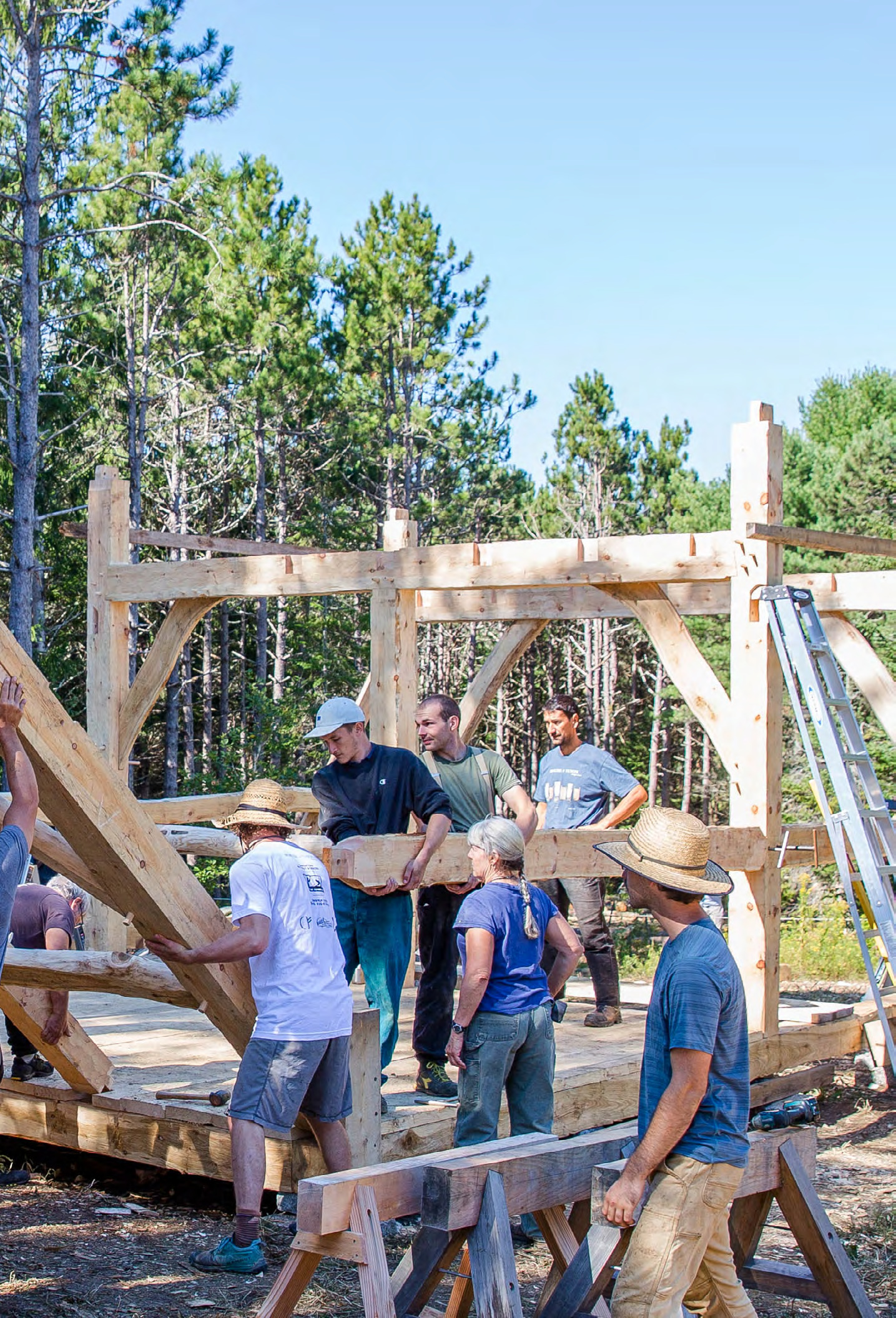
The ritual driving of the final pegs and king post wedge were special moments to behold. For these last parts, we disassembled the rope barrier around the site and invited the public to share this moment with us. The CSF team saved the honors of driving these final pieces for François and those who helped with the food, housing, and other details. Their installation is ceremonial and afforded us a special opportunity for expressions of gratitude and appreciation.
That evening, a local fiddle band arrived to lead us in contra dances in the woodshop. There was a lot of sweaty stomping and hollering ‘round-and-‘round and up-and-down on that shop floor. We dosey-doed our partners for a long while until François asked to say a few words. He talked about the bonds we now share across the borders of our countries. He also explained that our axes are symbolic weapons of mass “construction” – the building of the frame being a monument to the building of our deep friendship and shared conviviality. Then he presented me with a restored 19th-century French hewing axe as a token of our friendship – a generous gift I will always cherish.
We look forward to using this axe to work side-by-side with others for many years.
What is Possible in Your Life?
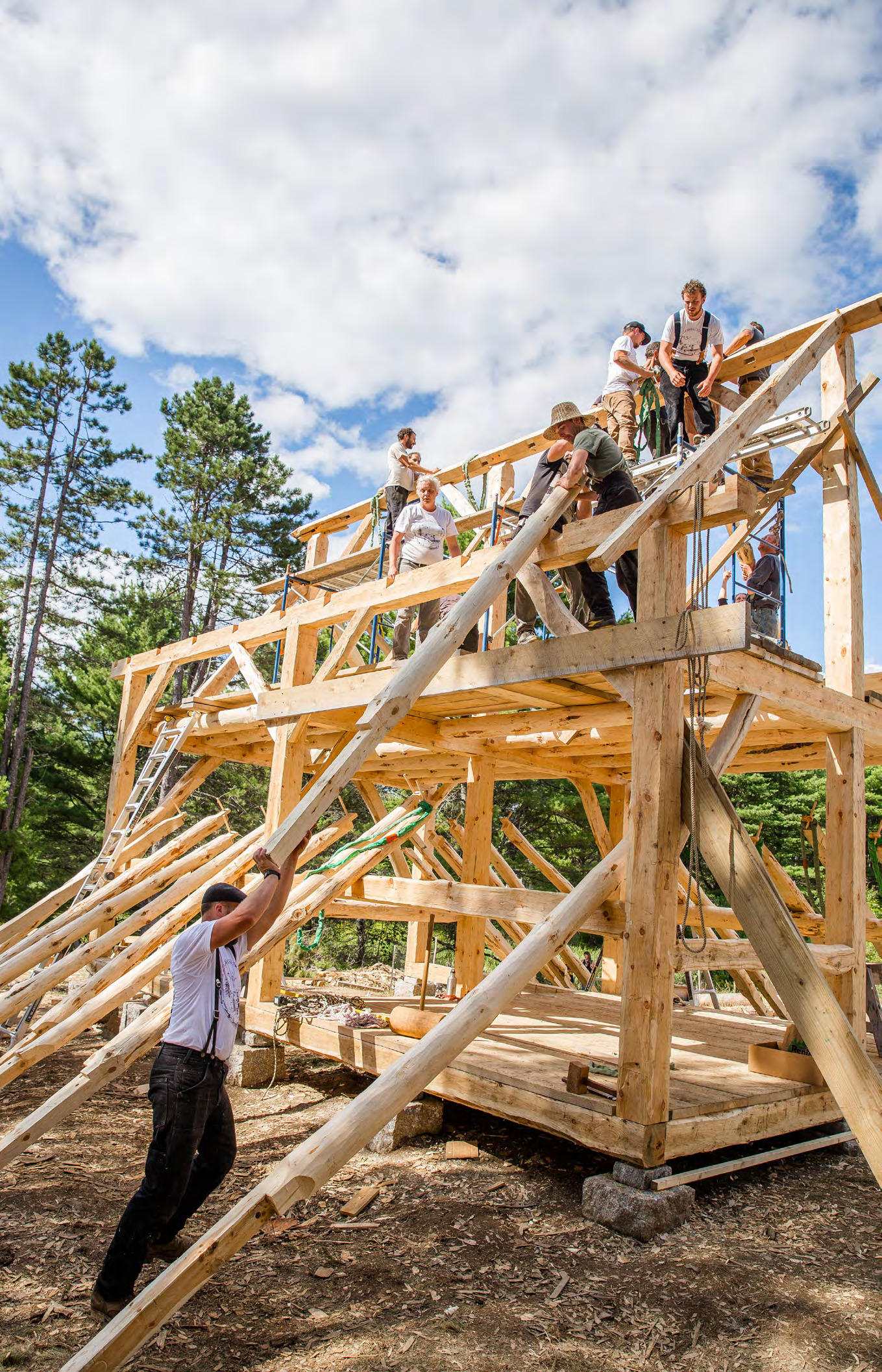
In its scale and intensity, this project is likely beyond most people's needs – not everyone will host a team of French carpenters to build a blacksmith shop. There are no longer horse loggers in every community, not everyone owns a plot of harvestable trees, and the congestion of urban life may preclude large-scale hewing operations.
Everyone’s circumstances are unique, and there are constraints intrinsic to each. If you’ve chosen to maintain a stable career, it often means you’ve committed to a particular geographical place. The joys of raising a family only come through relinquishing the autonomy of the single life. We all m ake choices. We pursue the things important to us: job, leisure, comfort, or family. Life is always an exercise in creating space for things we want to see flourish and grow.
But there are many things that can become possible for us, if only we are willing to make hard decisions and step out into the hope of something different. To succeed, we must hold the value of reaching our goals above the discomfort or inconveniences we may experience along the way. Although we all find ourselves in different life circumstances in pursuit of a variety of aims, it is important to realize that our options are never limited solely to what the mainstream industrial economy has to offer; Charpentiers Sans Frontières has shown that something else is possible.